What Is Tricky Ball?
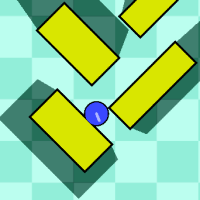
Tricky Ball is a physics-based puzzle game with 12 levels. You are tasked with creating a safe route that allows the ball to reach its destination.
You may need to rotate a shape, slide a platform, activate a switch, or reposition an object so the ball can continue along its path. Some objects can redirect the ball entirely, while others change the shape or stability of the route. This gives the Tricky Ball game a strong puzzle-solving element. You are not simply controlling the ball directly. Instead, you are changing the environment around it and allowing physics to determine what happens next.
Simple mechanics of Tricky Ball
The controls in Tricky Ball are intentionally simple. You tap or click interactive objects to move, rotate, or reposition them. There are no complicated combinations to memorize. Your challenge is understanding what each object does and deciding when to interact with it. Some shapes rotate when you tap them. Others slide into new positions. Certain objects can redirect the ball's trajectory, while switches or movable structures may open up a previously blocked route. The simplicity of the controls makes the puzzle itself the main focus.
Identify the Important Objects
Before making a move, take a moment to examine the entire level. Not every object needs to be changed. In fact, moving something unnecessarily can make the puzzle harder. Your first task is to determine which elements actually affect the ball's route. Look for:
- Movable platforms
- Rotating shapes
- Slopes and ramps
- Switches
- Obstacles
- Areas where the ball could fall
- The final destination
Once you understand how these elements interact, you can begin planning a route. This approach is particularly useful in later Tricky Ball gameplay, where several objects may influence one another. Moving one platform can change the ball's trajectory, which can then affect whether it reaches another platform safely.
Work Out the Correct Order
Knowing what to move is only part of the puzzle. You also need to determine when to move it. Some levels require several changes to be made in a particular sequence. If you adjust the final ramp before positioning another platform, for example, the ball may roll in the wrong direction. This is why experimentation is an important part of the game. If your first attempt fails, consider what caused the failure. Did the ball move too quickly? Was the ramp too steep? Did another object redirect it unexpectedly? Rather than changing everything at once, isolate the problem and adjust one element at a time. This makes it easier to understand the relationship between your actions and the resulting movement.
Use Ramp Angles to Control Movement
Ramps are particularly important because their angle can influence both direction and speed. A gentle surface may allow the ball to move more slowly and predictably. A steeper section can send it forward more quickly, which may be useful when you need to cross a gap but dangerous if another platform is difficult to reach. The goal is not always to make the ball move as fast as possible. Sometimes controlled movement is more useful than maximum speed. If the ball reaches the next section too quickly, it may pass the correct position or fall before you have a chance to establish a safe route. Think of ramps as tools for controlling movement rather than simple launch points.
How to control: Left mouse = Control obstacles.
Master All 12 Puzzle Levels
The 12 puzzle levels are designed to gradually introduce more complicated situations. Each stage presents a new arrangement, requiring you to reconsider how the objects can be used. The progression is important because it allows you to become familiar with the basic physics before dealing with more involved combinations. Early levels can help you understand how movable shapes behave. Later stages require you to combine several interactions and consider the consequences of each adjustment.
Tips for Better Tricky Ball Gameplay
Getting through the later stages of the Tricky Ball game is less about speed and more about observation. Before you interact with anything, examine the level. Identify the ball's starting position, the finish line, and the obstacles that stand between them. Then consider the natural direction of movement. Ask yourself where gravity will take the ball if you do nothing. From there, determine which platform or ramp needs to be changed to redirect that movement.
Plan the Route Before You Move
A useful strategy is to think backward from the finish line. Instead of immediately focusing on the ball's starting point, examine the final platform or ramp. Ask what the ball needs to do immediately before reaching the finish. Then work backward through the level. This can reveal which objects need to be repositioned and which ones can remain untouched. Planning in this way is especially helpful when multiple platforms interact with one another.
Control Speed as Well as Direction
Many puzzle solutions depend on more than getting the ball to the correct location. You also need to make sure it arrives with an appropriate amount of momentum. If the ball approaches a narrow platform too quickly, it may roll straight off. If it moves too slowly, it may not reach the next section. This makes speed management a central part of the game's physics-based design. Use slopes and platform positions to create the movement you need rather than simply trying to make the shortest possible path.