
Hide N Seek
 Mini Turbo Karts Halloween
 Mecha Formers
.avif "The Amazing Digital Dating Sim") The Amazing Digital Dating Sim
 Touchdown Rush
 Swingo
 Blumgi Soccer
 Hide And Smash
 Rainbow Friends Return
 Hide And Seek
 Hide and Escape from Angry Teacher
 Steal Brainrot Online
 Pixel Craft Hide and Seek
 Dye Hard
 Jailbreak: Hide or Shoot
 Mecha Run
 Brawl Stars Online
 Fortzone Battle Royale
 Hide And Paint
 Obby: Hide And Seek Battle Royale
 Metal Wing
 Heist io
 Paint or Hunt
 Build Royale
 Escape Tsunami for Brainrots
 War Brokers
 Among Us
 Monkey Tag IO
 Grow A Garden
 Survival Race
 RocketGoal
 Rumble Rush
 SuperBattle 2
 Ludo With Friends
 Juno Card Party
 Obby Roads
 Wood Nuts
 PolyTrack
 Pacman Full Screen
 Tennis Physics
 Cubes 2048
 Shark.io
 Simply Up
 Chameleon Hide And Seek
 eParkour
 State.io
 Bouncemasters
 Free Skate
 Tropical Merge
 Sausage Flip
 Volley Random
 Helix Jump
 Tanuki Sunset
 Tricky Ball
 Scary Teacher 3D
 Chess Grandmaster
 Red Ball 4
 Dragon Simulator 3D
The Original Inspiration
Hide-and-seek is one of the simplest games to understand. Someone hides, someone searches, and the objective is to find everyone before the activity ends. Its appeal comes from the excitement of discovering unexpected hiding places and the satisfaction of finding someone who seemed impossible to locate.
When developing Hide N Seek, we wanted to bring that familiar experience into a more structured digital environment. Rather than relying on a large outdoor area or a traditional multiplayer format, we chose a house as the central setting. This decision allowed us to create a collection of recognizable spaces where almost any object or piece of furniture could become part of the challenge.
A house provides an interesting environment for exploration because its rooms serve different purposes. A bathroom contains bathtubs and other fixtures, while bedrooms and living areas offer furniture, doors, closets, and corners that can conceal someone. These familiar objects make the game easy to understand, but they also create plenty of opportunities for unexpected hiding locations.
We also wanted the challenge to develop naturally. At the beginning, you can focus on learning how the environment works and identifying common hiding spots. As the difficulty increases, you need to become more systematic because overlooking even one child can prevent you from completing the stage.
Another important design decision was to remove time pressure from the search. We wanted you to concentrate on exploration rather than rushing through the house. This creates a different type of challenge: success depends on how thoroughly you investigate the environment, not how quickly you move from one room to another.
Finally, we introduced boosters to give you more control over your search strategy. Instead of forcing you to follow one approach, Hide N Seek lets you select one upgrade before a game begins. This adds a small but meaningful strategic decision to every attempt.
Your Main Objective in Hide N Seek
The main objective in this game is to locate every child concealed throughout the house and complete the current level.
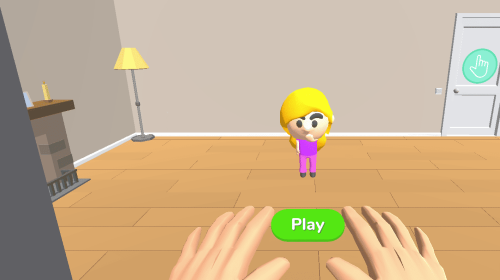
Figure 1: Game Screenshot
Each stage contains several hidden children, and they can appear in different areas of the environment. Some hiding places are relatively easy to recognize, while others require you to inspect the surroundings more carefully. Common hiding locations include:
- Behind doors, where a quick glance may not reveal someone standing out of sight.
- Inside closets, which can conceal children in enclosed spaces.
- In bathtubs, making bathrooms important areas to investigate.
- Around furniture, where objects can block your view.
- In less obvious corners, which are easy to overlook when exploring carelessly.
The absence of a countdown changes how you should approach each stage. You do not need to rush through the house or take unnecessary risks. Instead, focus on searching every accessible area and making sure that you have not missed a hiding place.
How to control
- Arrow or WASD keys = Move
- Mouse = Look around and open the door
Four Boosters in Hide N Seek
One of the most interesting features of this game is its booster selection system. Before each game begins, you can choose one upgrade to support your exploration. You cannot select all four boosters simultaneously, so your decision matters. Each option provides a different type of assistance, and the most useful choice depends on how you prefer to investigate the house.
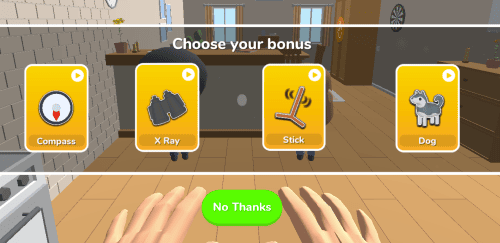
Figure 2: Four Boosters
Compass
The Compass is designed to make navigation easier. Once selected, it provides a directional arrow that guides you toward the general location of hidden children.
Instead of exploring the house without any indication of where to go, you can use the arrow to narrow down your search area. This is particularly helpful when a level contains several rooms or when you are unfamiliar with its layout. However, the Compass does not replace the actual search. The directional indicator helps you determine where to investigate, but you still need to examine the surrounding area and discover the exact hiding place. This is best for exploring larger levels, improving navigation, and reducing unnecessary wandering.
Dog
The Dog booster introduces an audio-based way to locate hidden children. Your search companion appears near concealed targets and barks to attract your attention.
Unlike a tool that reveals an exact position, the Dog provides a clue that requires you to listen and investigate. When you hear barking, pay attention to the surrounding area and check nearby hiding places. This creates a more interactive searching experience because you need to combine sound with visual observation. Rather than simply following a marker, you must interpret the audio information and decide where to look next. The Dog is especially useful when you enjoy exploring naturally while receiving additional hints along the way. This booster is best for following audio clues, discovering nearby hiding places, and making exploration more interactive. Remember that the barking indicates proximity rather than an exact hiding location. Check the surrounding furniture, doors, and corners before moving to another room.
X-Ray
X-Ray is the most direct assistance option among the four boosters. Once activated, it reveals the positions of all children who are still hiding inside the house.
This changes how you approach a level. Instead of trying to determine which rooms might contain hidden children, you can immediately identify the locations that require attention. The upgrade is particularly valuable during advanced stages, where the number of possible hiding places can make searching more complicated. It also helps reduce the chance of overlooking a child after you have already investigated several rooms. Although X-Ray provides substantial assistance, you still need to navigate the environment and reach the revealed positions. This booter is suitable for difficult stages, identifying remaining targets, and completing searches with fewer missed locations.
Stick
The Stick provides a proximity-based warning system. When you move close to a hidden child, the stick begins to swing, indicating that someone may be nearby.
It does not reveal the target's exact position. Instead, it helps you narrow down the search area and encourages you to inspect your surroundings more carefully. This makes the Stick an interesting middle ground between independent exploration and direct assistance. You still need to figure out where the child is hiding, but you do not have to rely entirely on guesswork. For example, if the stick starts swinging near a piece of furniture, you can inspect the surrounding area, check behind nearby objects, and look for other possible hiding places. This booster can be used for room-by-room exploration, proximity detection, and discovering hidden children through observation.
Smart Tactics to Win Hide N Seek
Although the basic objective is simple, completing every level consistently requires a good searching method. The following strategies can help you avoid missed hiding places and make better use of your selected booster.
Search Every Room Before Moving On
One of the most common mistakes is leaving a room after checking only its obvious hiding locations. A child might be behind a door, inside a closet, or concealed near furniture that you initially overlooked. Before leaving an area, examine the available hiding places carefully. Pay particular attention to objects that create enclosed or partially hidden spaces. A quick look across the room is not always enough to identify everything.
Develop a Consistent Search Pattern
Random movement makes it difficult to remember which locations you have already checked. A predictable routine can make the process much more organized. Try the following approach:
- Enter one room and examine the overall layout.
- Check doors, closets, and other enclosed spaces.
- Inspect furniture and surrounding corners.
- Look behind objects that may block your view.
- Confirm that the room has been thoroughly searched.
- Move to the next room and repeat the process.
You can also move clockwise through the house or follow another consistent route. The important thing is to avoid repeatedly checking the same areas while forgetting others.
Select a Booster That Matches the Difficulty
Your booster choice should reflect the type of challenge you are facing. The Compass is helpful when navigation is your main concern. The Dog provides audio clues that make nearby targets easier to investigate. X-Ray is particularly useful when you need direct information about remaining hiding positions, while the Stick offers subtle proximity warnings. Do not automatically choose the same upgrade every time. Consider what makes the current search difficult and select the tool that addresses that problem.
Listen Carefully to the Sound Effects
Audio is another source of information in Hide N Seek. This becomes especially important when you select the Dog booster. When barking occurs, avoid ignoring it or immediately moving to another room. Stop and examine the nearby area. The sound provides a reason to investigate, and combining it with visual clues can help you find the hidden child. Paying attention to sound effects also makes the exploration experience more engaging because you are using more than just what appears on the screen.
Recheck Areas When You Cannot Find the Final Child
Sometimes, you may feel that you have searched the entire house but still have one child left to find. Instead of repeating the same route without a plan, review the rooms you have already visited. Think about which hiding places received only a quick inspection and which objects might have been overlooked. If you selected X-Ray, use its revealed positions to identify the remaining search areas. With the other boosters, pay attention to directional guidance, barking, or proximity warnings to narrow down your next move. A careful second inspection is often more productive than starting another random search.
Multiple Difficulty Levels in Hide N Seek
This arcade game features multiple difficulty levels, allowing the challenge to become more demanding as you progress. The basic objective remains unchanged: find every hidden child before advancing. However, later stages require more attention because overlooking a single location can prevent you from completing the level. This progression encourages you to improve your exploration habits gradually. Early stages provide an opportunity to become familiar with the house, understand the hiding mechanics, and learn how to use each booster.
As you advance, the importance of an organized search routine becomes more apparent. You need to remember which rooms have been inspected, recognize less obvious hiding locations, and decide when additional assistance is worth using. The lack of a time limit makes this progression more approachable. You can take a moment to reconsider your approach instead of feeling pressured by a countdown.
For us as the developers, this balance between accessible controls and increasingly demanding searches is an important part of the game's identity. You can understand what to do almost immediately, but completing more challenging stages rewards patience and a willingness to pay attention.