Hide And Paint
 Mini Turbo Karts Halloween
 Mecha Formers
.avif "The Amazing Digital Dating Sim") The Amazing Digital Dating Sim
 Touchdown Rush
 Swingo
 Blumgi Soccer
 Hide And Smash
 Rainbow Friends Return
 Hide And Seek
 Hide N Seek
 Hide and Escape from Angry Teacher
 Steal Brainrot Online
 Monkey Tag IO
 Pixel Craft Hide and Seek
 Grow A Garden
 Survival Race
 Dye Hard
 Jailbreak: Hide or Shoot
 RocketGoal
 Rumble Rush
 Mecha Run
 Brawl Stars Online
 SuperBattle 2
 Ludo With Friends
 Juno Card Party
 Obby Roads
 Fortzone Battle Royale
 PolyTrack
 Pacman Full Screen
 Obby: Hide And Seek Battle Royale
 Cubes 2048
 Metal Wing
 Shark.io
 Chameleon Hide And Seek
 State.io
 Heist io
 Paint or Hunt
 Build Royale
 Escape Tsunami for Brainrots
 War Brokers
 Among Us
 Wood Nuts
 Tennis Physics
 Simply Up
 eParkour
 Bouncemasters
 Free Skate
 Tropical Merge
 Sausage Flip
 Volley Random
 Helix Jump
 Tanuki Sunset
 Tricky Ball
 Scary Teacher 3D
 Chess Grandmaster
 Red Ball 4
 Dragon Simulator 3D
The Creative Idea Behind Hide And Paint
The inspiration for Hide And Paint came from exploring a different approach to the traditional hide-and-seek formula.

Figure 1: Traditional Hide And Seek
In a conventional game, finding a good hiding place usually means staying behind an obstacle, moving away from the search area, or choosing a location that is difficult to access. We wanted to introduce a more imaginative challenge. What if you could hide in plain sight instead of disappearing behind something? What if the environment itself became your greatest tool for avoiding discovery?
This concept led us to develop a camouflage-based multiplayer experience inspired by Meccha Chameleon. The idea is straightforward: your character can use paint to resemble nearby objects, making it harder for the Seeker to distinguish a disguised opponent from the actual environment.
However, visual camouflage alone does not determine the outcome. Your position, movement, and understanding of the map all influence how convincing your disguise becomes. A character with perfectly matched colors can still attract attention if the chosen location looks unnatural.
We also wanted the opposing role to offer an equally engaging experience. The Seeker should not simply walk around the map looking for obvious characters. Instead, the role requires you to investigate your surroundings, recognize visual inconsistencies, and react quickly when you discover a target.
By combining these ideas, we created Hide And Paint as a game of two competing abilities: the ability to deceive through camouflage and the ability to recognize deception through observation.
How to Play Hide And Paint
Every match in Hide And Paint revolves around two roles with different objectives. Understanding their mechanics will help you make better decisions and adapt to the situation more effectively.
Play as a Hider
When you receive the Hider role, your objective is to survive until the round ends without being discovered and eliminated by the Seeker.
Although the mission sounds simple, successful hiding requires more preparation than you might expect. You cannot rely entirely on finding an isolated corner. Instead, you need to examine the environment and choose a disguise that looks like a natural part of the map. The painting mechanic is the most important tool available to you. By matching your appearance to nearby objects, you can make it significantly harder for the Seeker to identify your position. Here is how to approach the Hider role:
Observe before choosing your disguise.
Before settling on a hiding location, examine the surrounding objects. Look at their colors, shapes, and general appearance. A suitable disguise should complement the environment rather than stand out from it. For example, if you notice several objects with similar colors nearby, consider whether your character can blend into that visual arrangement.
Choose a location that looks natural.
A good hiding position should make sense within the environment. Avoid selecting a spot simply because it is far away from the Seeker's starting location. An exposed position can sometimes work better when your disguise fits the surroundings. Think about how the Seeker will interpret the scene when entering the area. Your objective is to make your presence seem unremarkable.
Use paint carefully.
Painting yourself is not just a cosmetic action. It is a central part of your survival strategy. Choose a disguise that resembles the objects around you, paying attention to the overall appearance rather than focusing on a single color. A convincing visual match makes it more difficult for the Seeker to recognize that something is different.
Control your movement.
Movement can reveal your position, especially when the Seeker is inspecting nearby objects. Once you have found a suitable location and established your disguise, avoid unnecessary repositioning. Patience is particularly important when your surroundings already provide a good camouflage opportunity.
Stay focused until the round finishes.
Finding a hiding place does not mean your work is finished. The Seeker may eventually enter your area, so remain attentive and avoid making decisions that could expose your character.
Become the Seeker
The Seeker role completely changes your objective. Instead of trying to become part of the environment, you must identify the Hiders hiding among ordinary objects and shoot them before they survive the round.
This role combines investigation, reaction speed, and aiming accuracy. You need to recognize suspicious details while making sure you can successfully eliminate a target once you find one.
Inspect the environment carefully.
Do not assume that every object is exactly what it appears to be. A disguised Hider may look almost identical to something nearby, but small differences in appearance can reveal their position. Pay attention to unusual shapes, colors, and placements. Even a subtle visual inconsistency may indicate that an object is not part of the original environment.
Search one area at a time.
Moving randomly across the map can make your search less effective. A more systematic approach allows you to inspect individual sections without repeatedly overlooking the same places. Check rooms, examine groups of objects, and move to another area once you have investigated the current one.
Avoid focusing only on obvious hiding spots.
Experienced Hiders may choose unexpected locations. An object that seems ordinary at first glance could actually be a carefully disguised opponent. Keep your attention open to different possibilities instead of relying on the same search pattern in every match.
Improve your shooting accuracy.
Discovering a Hider is only part of your responsibility. You must also shoot accurately to eliminate the target. Poor aim can waste valuable time and give the opponent an opportunity to escape or reposition. Developing both observation and aiming skills will make your performance as a Seeker more consistent.
How to control
- Arrow keys = Move around.
- Spacebar = Jump.
- Left mouse = Shoot.
- Q key = Open the quests.
- V key = Play with friends.
- G key = Pose.
- F key = Paint.
All Six Maps in Hide And Paint
Map variety is one of the defining features of this multiplayer game. We included six different environments to create new camouflage opportunities and prevent every match from feeling identical.
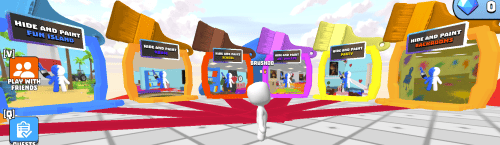
Figure 2: Seven Maps
Each location has its own visual identity, object arrangements, and hiding possibilities. Learning how to use these differences can improve your performance regardless of the role you receive.
Party Map
The Party map features bright decorations and a variety of objects that create interesting opportunities for camouflage.
As a Hider, you can examine the surrounding decorations and look for visual combinations that make your disguise appear natural. The variety of objects also gives the Seeker plenty of details to investigate.
Backrooms
Backrooms introduces a mysterious atmosphere with an unusual layout and limited visibility.
This environment challenges your ability to understand the surroundings. Hiders need to identify suitable hiding positions, while Seekers must carefully inspect unfamiliar areas instead of depending entirely on visual memory.
School
The School map brings a recognizable educational setting into the game. Classrooms, desks, and other school-related equipment create several possibilities for creative disguises.
For Hiders, familiar objects can provide useful camouflage opportunities. For Seekers, the challenge is recognizing when something does not belong among the classroom furnishings.
House
House features a familiar home environment filled with furniture and household decorations.
Its everyday setting encourages you to pay attention to ordinary details. A successful Hider can use the visual characteristics of nearby furniture to create a convincing disguise.
Meanwhile, the Seeker needs to distinguish between natural household objects and opponents attempting to imitate them.
Art Gallery
Art Gallery offers one of the most visually interesting environments in Hide And Paint.
Paintings, sculptures, and decorative displays create a setting where colors and shapes play an important role. This makes the map particularly suitable for experimenting with different camouflage approaches. Seekers should examine the arrangement of displays and look for details that seem inconsistent with the surrounding artwork.
Fun Island
Fun Island introduces colorful scenery and a playful atmosphere that creates a different experience from the more familiar indoor environments. Its varied surroundings encourage creative thinking. You can experiment with different disguises as a Hider or challenge yourself to inspect the environment thoroughly as a Seeker.
Many Quests in Hide And Paint
This game offers more than individual matches through its quest system. These objectives give you additional reasons to explore different parts of the game while rewarding consistent progress with bonus gems.

Figure 3: Quest List
Instead of focusing exclusively on winning each round, you can work toward specific achievements that encourage you to experiment with different roles and maps. Some of the featured quests include:
- Complete 100 wins: Work toward a long-term achievement by consistently participating in matches and improving your performance.
- Find 3 Hiders: Focus on your Seeker skills and successfully discover three disguised opponents.
- Win one match on Fun Island: Explore this colorful environment and secure a victory on its unique map.
- Win one match on Art Gallery: Adapt your camouflage or searching strategy to the artistic surroundings.
- Win one match on Backrooms: Test your environmental awareness in this mysterious setting.